
Getting Past No is a book fit for any negotiator, manager, business owner, or change agent. It’s 1 in a 3 part series by William Ury focusing on the various dynamics of negotiation and common to mutually beneficial agreements. I found Ury’s method approachable, systematic, and complete for overcoming the “No” in a negotiation but not necessarily Getting to Yes which is the title of one of the other book in the series! The “no” dynamic as well as the various constraints, roadblocks, and mindsets have a fundamentally different dynamic than one already working towards an agreement. I felt this book was packed with good examples, thorough in its explanations of psychology, but with a methodology that, with practice, could be a useful tool in your toolbox.
How Can I Help?

Ram Dass does a splendid job providing the reader with rich examples as well as clear insights into the dynamics of service and helping others. Additionally, it instructs the reader in a kind of mindfulness practice when helping others and in service, from deciding to offer help, the act of help and service, through moving on from the helping interaction. It was recommended on BJ Miller’s list of must reads for healthcare professionals and those interested in how to deepen their practice of service. I recommend this book for people in service for volunteering, healthcare, senior care, or who are currently caring for a loved one with a long term illness.
Principles: Life and Work

Ray Dalio is the founder and long time CEO (now Co-Chairman) of his hedge fund Bridgewater. The first 3rd of the book describes his journey through writing and refining these principles over 30 years of operating his company. He had systematized and computerized the analysis and management of their financial portfolio and eventually, Ray figured out that he MUST systematize (and in some ways computerize!) the management system of Bridgewater. Principles is the public version of those principles. Ray does a splendid job in describing varying methods of using the book, reading the book, and integrating the methods into your work and life. It’s approachable to all readers, of all ages, of any discipline or career path. It’s clear, concise, organized, and very pragmatic. This book is now in my Top 10 books, for ANYTHING, and I’ll be sure to share these principles (and as he suggested, the ones modified to fit your personal and professional life) with my children. I recommend this book for essentially anyone in their personal and professional lives who want exposure to what principles are at a minimum but at the other end, for those who want a systematized practice for life and work.
On Grand Strategy

Gaddis lays out a comprehensive examination of Strategy that has been employed by the human race. While it’s described through historical examinations of military and political history, the lessons learned are applicable to any circumstance where you’re employing human effort and systems to increasingly large quantities of time, space, and scale (the books description). I found the “time, space, and scale” description THE most clear and concise description of what Strategies purpose and fundamental benefit is for business, politics, or even your personal life. I recommend this book for all leadership, strategy consultants, military professionals, and even Industrial & Systems Engineers to get a clear grasp of a systems tactical/tangible characteristics as well as it’s higher order structures. This book is in my Top 5 strategy books and a must read.
Training Within Industry: The Foundation of Lean

This book is in the Top 10 Books of Continuous Improvement but most Lean, Six Sigma, Theory of Constraints, Agile, or whatever other flavor you want to pick, even among Industrial & Systems Engineers, wouldn’t know it! This book is rich in the history of continuous improvement, job methods and training, and program development, but also delivers practical, clear, concise, and proven methods. Training Within Industry is a little known organization that grew after World War I but was essential to the Allie’s winning World War II. It’s fundamental purpose was to design training and continuous improvement methods to ramp up the US production capacity and throughput to deliver much needs armament and supplies to the war fighters. What they did was nothing short of amazing, on the order of the Manhattan Project in my opinion, as it set the trajectory of the US to become the sole powerhouse of manufacturing in the world for decades to come. They trained millions of workers, across every conceivable industry, to design better work processes, train people in them, and improve them but also build sustainable programs in their organizations to continue on. I recommend this book for every Industrial and Systems Engineer, Continuous Improvement Expert, Manufacturing and Operations Managers, and Trainers of all kinds. You won’t be disappointed.
Managing Transitions: Making the Most of Change

In “Managing Transitions” author William Bridges explores his conception of Organizational Transitions. This stems from his research, consulting experience, and design work from another book, “Transitions”. He lays out practical questions that need to be addressed at each stage of an organizations lifecycle, how to prevent complete demise, and leadership tactics and characteristics required to manage the evolution of their organizations. I recommend this book for HR professionals, Organizational Effectiveness experts, continuous improvement experts, and Leaders and Managers in general.
On Strategy from Harvard Business Review's "10 Must Reads"

This compendium on Strategy from the Harvard Business Review is a classic, must read selection of their top articles on Strategy. Many of these authors have since gone on to publish books built from the core theses’ of their articles. Michael Porter’s “What is Strategy?” is a fundamental explanation of Strategy in a business industry setting, where the power is and where the profit is held. Each author lays out their framework for developing, understanding, analyzing, and implementing strategy in any organization, business, non-profit, or otherwise. If you want a clear and approachable primer to the fundamentals of strategic thinking, look no further than this classic as a launching point.
Where Good Ideas Come From: The Natural History of Innovation

Johnson’s book “Where Good Ideas Come From: The Natural History of Innovation” is a book that started and went in a direction I completely unanticipated. It is highly readable, with numerous references and examples to great minds and thinkers of history, but that brings network science, psychology, sociology, organization design, and much more to develop a deep understanding of how good ideas are discovered, developed, and brought to use in our lives. He has 7 key drivers that bring about Good Ideas and with clear examples, elaborations, and an approachable style he brings a difficult scientific subject and applies it with ease to this much sought after subject of creativity and good ideas. I recommend this book for any creatively minded person, no matter the discipline or interests, for innovative business leaders, for engineers as well as entrepreneurs. It’s on my lists of “fundamentals” to learning, creativity and innovation, and successful structure for life and organizations in an increasingly competitive and changing world.
Scale: The Universal Laws of Life, Growth, and Death in Organisms, Cities, and Companies
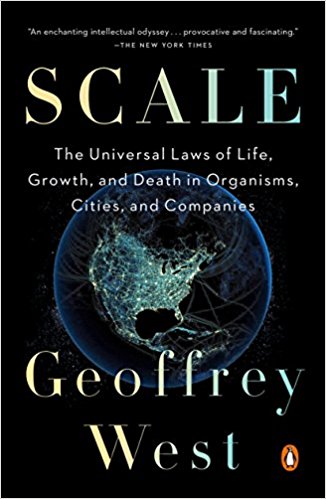
Geoffrey Wests book “Scale” is an amazing exploration of the science of complexity, network theory, and how scaling relationships amongst all kinds of systems permeate our world. With enough technical detail to be a useful reference in future applications and research but accompanied by a highly readable literary style, West explores scaling fundamentals in organisms, organizations, and cities. These sets of mathematical relationships underpin not only the growth rates of these varying systems but also resource consumption, energy production, maximum and minimum size limitations, and eventual death and decay. I recommend this book to anyone interested in the science of complexity and networks, systems theory, and industrial and systems engineering, but also for futurists and strategic thinkers grasping for fundamental principles of nature that can help guide their visions, strategies, and predictions for the future.